
Welcome to your Stand Out Performing Arts resource hub, a space designed to support your individual journey and technical growth. Here you will find the tools and expert advice you need to nurture your talent, refine your practice, and build the confidence to truly shine.
Vocal Warm-Ups & Straw Phonation
Straw phonation (singing through a straw) is one of the most effective vocal warm-up and cool-down exercises used by professional singers and voice therapists worldwide. Singing or vocalising through a narrow straw creates what is known as a Semi-Occluded Vocal Tract (SOVT) - meaning the airway is partially blocked, which creates a gentle resistance.
This resistance does something remarkable: it encourages the vocal folds to vibrate efficiently without strain. Think of it like physiotherapy for your voice—it strengthens and stretches the muscles of the larynx in the safest possible way.
The benefits include:
Warming up the voice quickly and gently without fatigue.
Reducing vocal strain and tension - ideal before a performance or a long rehearsal.
Strengthening the voice over time through consistent use.
Cooling the voice down after intensive singing to aid recovery.
Brilliant for students who suffer with nerves - the straw gives you something to focus on and instantly reduces throat tension.
Sophie personally recommends using specialist singing straws for these exercises.
Please click here to view the Rayvox Singing Straw.
How to Use Them
Simply vocalise (hum, sing a scale, or lip trill) through the straw on a sustained note or simple melody. You should feel a slight resistance and a buzzing sensation. Start with 5–10 minutes at the beginning of your practice session. Used consistently, straw phonation is one of the most powerful tools in any singer's daily routine.
Anatomy Of The Voice
Understanding the anatomy of the voice is just as important as learning songs and vocal technique; we like to call it "Singing Science." Knowing how and why you are using your voice helps you sing safely, confidently, and effectively, rather than simply singing without understanding exactly what you are working on. We will explore the key structures involved in vocal production, including the larynx (voice box), vocal folds, the diaphragm, and the intercostal muscles. By learning how these parts of the body work together - from the way the vocal folds vibrate to create sound to how the pharynx and oral cavity act as resonance chambers - you can make informed choices, develop a healthy technique, and truly understand the mechanics behind your own unique sound.
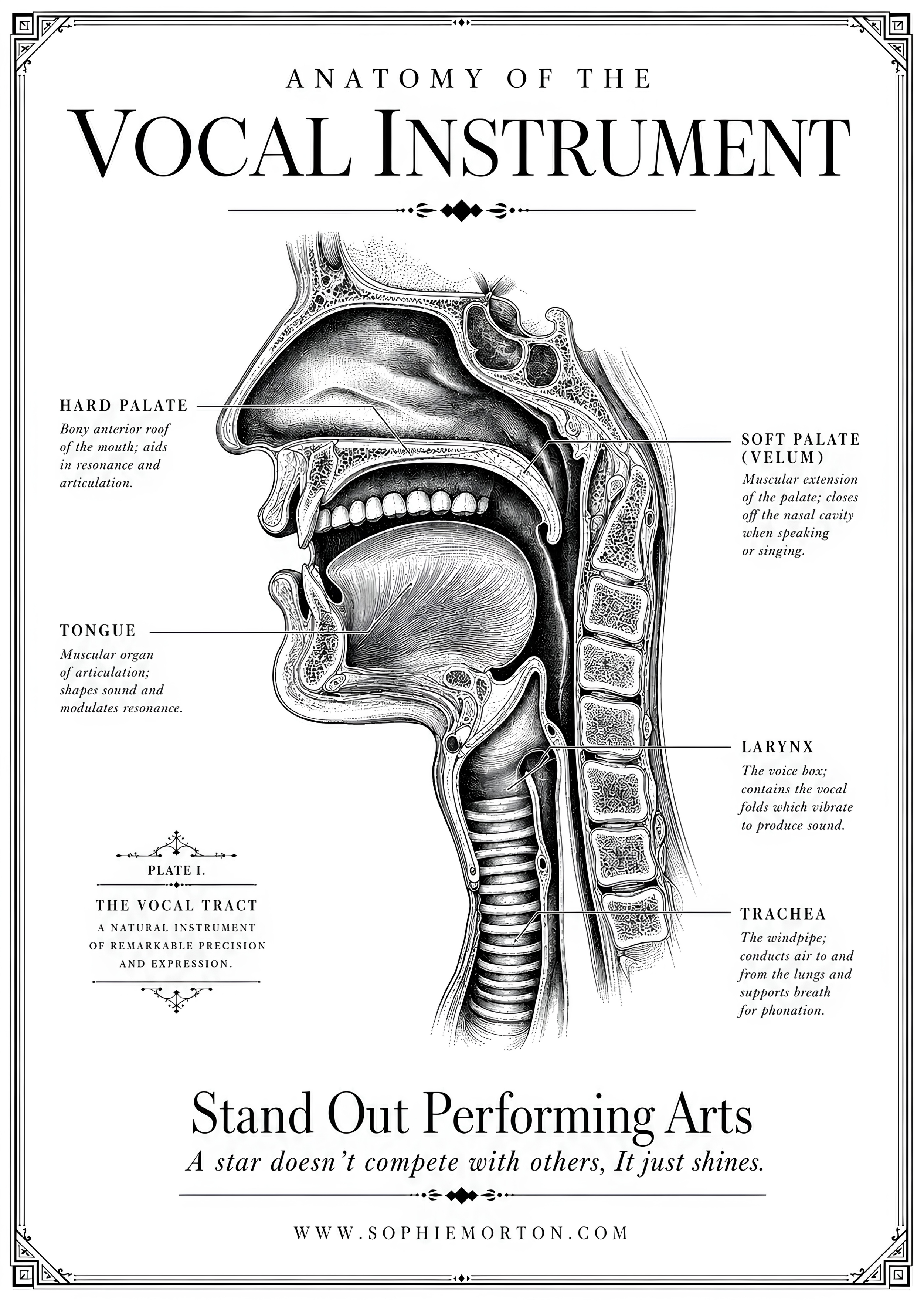
Anatomy of the Vocal Instrument | Singing Physiology & Vocal Anatomy Poster
Please click here to explore our full collection of posters and worksheets at The Stand Out Shop.
Estill Voice International - estillvoice.com
EstillVoice is one of the world's leading vocal training organisations, and Sophie is currently attending their courses and webinars. She highly recommends their resources for any student who wants to truly understand how their voice works.
What Makes Estill Voice Special?
Most singing training focuses on what to do - Estill Voice teaches you why it works. Their approach is deeply rooted in the science and anatomy of the voice, giving students the biological knowledge to understand, protect, and develop their instrument for life.
Their resources include:
Online Courses and Webinars: Covering the anatomy of the larynx, vocal fold function, and resonance.
Expert Training for All Levels: From beginners to professional performers.
Advanced Research: A body of work that underpins much of modern professional vocal training.
Versatile Stylistic Training: Understanding how to use your voice safely across different genres, including musical theatre, pop, classical, belt, and mix.
Understanding how your voice works anatomically doesn’t just make you a better singer - it protects you from injury and gives you the tools to solve vocal problems yourself. Sophie is passionate about this approach and incorporates Estill principles into her teaching. She encourages all students and parents to explore the Estill website for articles, resources, and upcoming events.
Backing Tracks Vs Full Recordings
This is one of the most important pieces of practice advice Sophie gives to every student, and it can make a huge difference to your progress:
Once you know a song - stop singing along with the original artist.
When you are first learning a song, it is absolutely fine to listen to the full recording with vocals to familiarise yourself with the melody, rhythm, and words. But once you feel confident with all three — once you know the words, you know the tune, and you know the rhythm — it is time to switch to a backing track only.
Here is why:
When you sing along with the original artist or cast recording, you naturally lean on their voice. You follow their timing, their breath, and their dynamics. This feels comfortable, but it means you are not truly developing your own interpretation, your own timing, or your own technical control. You are essentially being carried.
Practising with a backing track means:
• You are in full control of your own timing and phrasing.
• You are forced to lead the song rather than follow it.
• You develop your own artistic voice and interpretation.
• Your breathing, dynamics, and technique are entirely your own.
• You will perform far more confidently when it counts — because you have never needed the vocal track to hold you up.
The only time to use a vocal track during practice is if you are unsure about something specific — a tricky note, an unusual rhythm, or a word you keep getting wrong. In that case, listen back to the vocal version for that section only as a reference point, then return to the backing track.
Where to find backing tracks:
Search YouTube and karaoke-version.com for free and customisable options.
Please Click Here To Go Back To The Backstage At Stand Out Performing Arts Homepage.